
The cards were on the table, the dice had been rolled, and a kid who hadn’t said much all session started talking. Really talking. Not because they were asked to. Not because an adult had steered the conversation there. But because the game had quietly made it feel safe enough to try.
That moment doesn’t happen by accident. It happens because someone felt like they weren’t being tested. Like there was no wrong answer. Like the adult across the table wasn’t an authority figure with an agenda. Just a person, showing up, playing a game with them.
And it turns out, that’s everything.
It’s not that families don’t want to talk about the hard stuff. Bodies. Boundaries. Relationships. Growing up. It’s that nobody gave them a way in that didn’t feel awkward, or clinical, or like a lecture wearing a costume. Kids shut down. Adults stumble. The moment passes. And slowly, without anyone deciding to, these topics become the ones you just don’t bring up.
EyesOpenIowa has spent nearly 30 years believing that wall doesn’t have to stay up. What the community taught us, over and over again, is that the how matters just as much as the what. You can have the right questions and still lose the room.
And right now, the stakes of getting this right have never been higher. Nearly 40% of high school students in America reported persistent sadness or hopelessness in 2023. Youth suicide rates have risen sharply over the past two decades. These aren’t abstract numbers. These are kids in our communities, in our families, who are struggling in a world that is moving faster and feeling lonelier than ever before.
At the same time, more than half of parents say screens interfere with quality family time, and yet a quarter of kids report using devices during meals. We live in the most connected era in human history and are somehow raising the most disconnected generation. Our phones are always in our hands, and the conversations that matter most keep getting pushed to later, to someday, to when things slow down.
Here’s what the research tells us though: parental involvement changes outcomes. Kids who have open, ongoing communication with the adults in their lives engage in fewer risky behaviors, show better mental health, and are more likely to ask for help when something goes wrong. Parents are the single most powerful influence on a young person’s decisions about relationships, bodies, and growing up. Not the school. Not the curriculum. Not whatever policy happens to be in place that year. The adult at home who is willing to sit down and try.
We can’t wait for someone else to start this conversation. We can start it ourselves.
When we mailed game kits to families across the country, we genuinely didn’t know what we’d get back.
What we got back changed everything.
Families told us the game created an opening they didn’t know how to make on their own. Youth brought topics back up days later, on their own, unprompted, because something about the experience had made the conversation feel like a place they could return to.
“We’ve tried to have conversations like this before. They usually don’t go anywhere. But this time, it did.”
“It got less awkward the more we played.”
“It felt more normal to talk about weird things we usually would avoid.”
Those aren’t marketing lines. Those are words people wrote on survey forms they didn’t have to fill out. And every single one of them told us the same thing: the wall comes down. It just needs the right door.
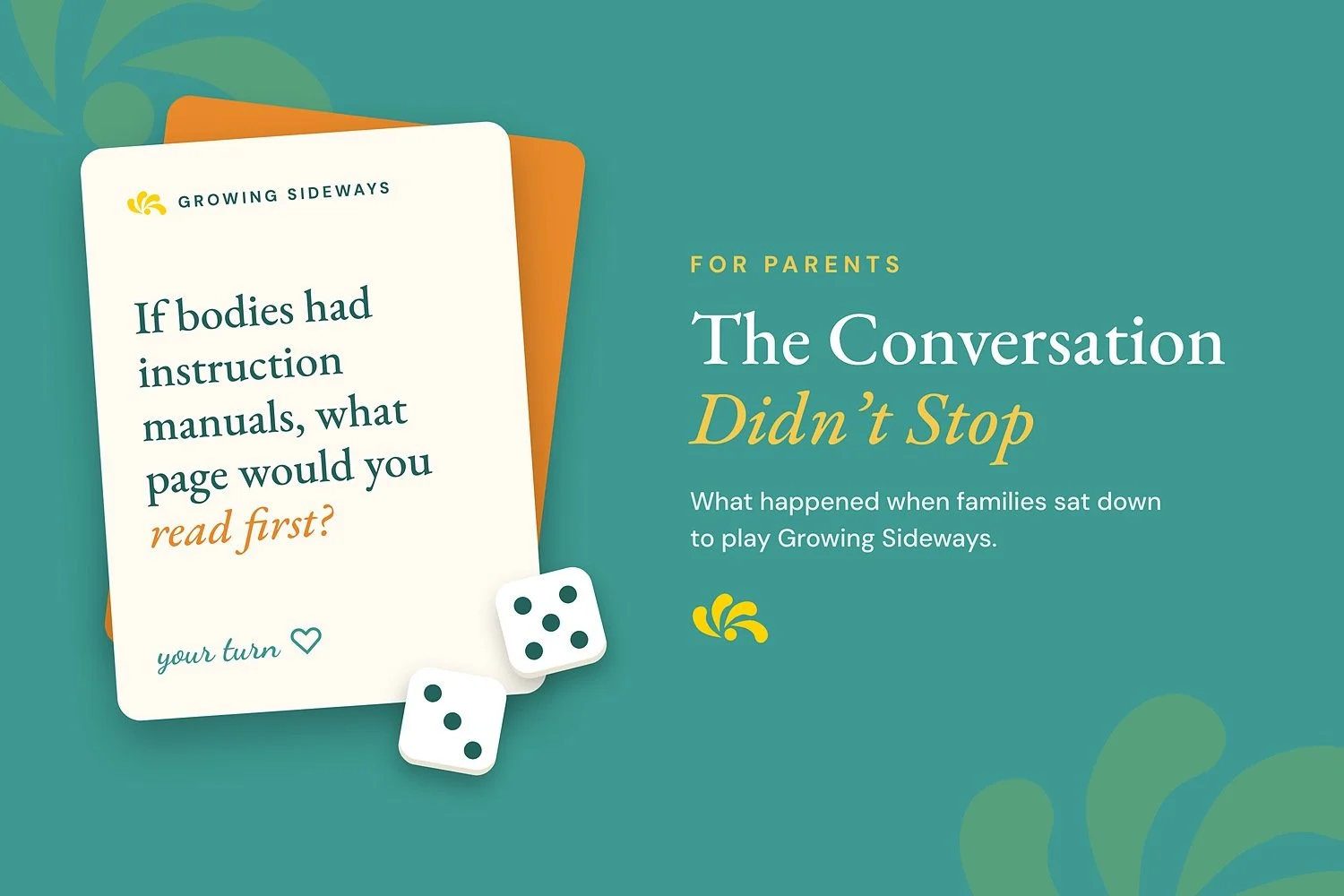
One of the cards asks: “If bodies had instruction manuals, what page would you read first?” It sounds simple. Maybe even a little funny. But around a table, that question opens something up. It’s not clinical. It’s not a lecture. It’s an invitation, and it meets kids and adults exactly where they are.
Four rounds of testing. 41 family units. 111 survey responses. Every piece of feedback became something real. A revised card. A new category. A mechanic we hadn’t considered. When players told us the dice sparked a competitive energy nobody expected, that it made the game exciting and not just meaningful, we leaned in. When they asked for more interactive challenges, more role-play, more moments where the whole table had to get involved, we listened. The version of Growing Sideways that exists today was built by the community it was built for.
That’s what I want our stakeholders and supporters to understand, maybe
more than anything else: this isn’t a product we made and handed over.
It’s a conversation we started, and communities across Iowa and beyond
have been shaping it ever since.
The ripple effect of one good conversation at a family game night isn’t
something you can easily measure. But I’ve seen it. A child who learns
they can ask hard questions and get real answers carries that forward. A
caregiver who finds the words once finds them again more easily the next
time. Connection builds on connection. Empathy grows where it’s
practiced.
Nobody arrives knowing how to talk about growing up. Not the kids living
it, and not the adults who’ve been there long enough to forget how
uncertain it felt. The awkwardness around these conversations isn’t a
flaw. It’s just unfamiliarity. And the only way to make something feel
normal is to do it, again and again, until it is.
Growing Sideways exists to make that easier to start. To give families
something to pick up when they don’t know where to begin, and to keep
coming back to. Because every time they do, it gets a little less uncertain.
A little more natural. A little closer to the kind of open, trusting
relationship that genuinely changes the course of a young person’s life.
That’s what we’re working toward. Not just a game, but a generation that
carries less silence than the one before it. One where the adults in a
child’s life felt equipped to show up, and did. We believe that starts at the
table, with the people who love them most, one conversation at a time.
This version of Growing Sideways is still finding its final form, and that’s
intentional. Community has shaped this game from the very beginning,
and the survey inside every box is how that continues. Some cards are
still being tested, some are still being refined, and every family that plays
and shares their experience becomes part of what this game becomes
next.
Growing Sideways is available now. A limited community edition, $25.
Real families, real conversations, still growing. Every copy includes a
feedback survey because we mean it: we’re not done listening.
If you believe in building with communities rather than for them,
this game was made alongside yours.
Growing Sideways is available at eyesopeniowa.org/shop. To connect, share feedback, or talk about how this work fits your mission: maddy@eyesopeniowa.org
By Madalyn Fairholm
Innovation and Engagement Lead
Sources: CDC / NCHS (2023); Annie E. Casey Foundation (2024); Pew Research Center (2025); Common Sense Media Census (2025); Youth.gov Family Engagement Research.