From the Monthly Memo

Meta’s Settlement and the Long Reach of Unintended Harm

Meta’s Settlement and the Long Reach of Unintended Harm

On August 26, Meta, the company behind Facebook and Instagram, settled a major lawsuit brought by a coalition of states over how its platforms affect young users, and a federal judge approved the agreement. Meta will pay at least $12 billion over ten years, and up to about $17 billion if other social media companies reach similar settlements. It also agreed to change how minors experience its apps.

The states alleged that the platforms were designed to be addictive for young users, that Meta misled the public about known risks, and that it collected personal data from children under 13. Meta did not admit wrongdoing. Under the agreement, protections for users under 18 include a two-hour daily time limit, a block on use from midnight to 6 a.m., limits on notifications overnight and during the school day, a ban on cosmetic filters, hidden “like” counts, a chronological feed option, and regular reviews by an independent auditor.

What stands out is not just the dollar figure but the nature of the harm. Much of it was not loud or obvious. It built slowly, through choices whose long-term effects on young minds were not fully weighed at the time. That is often how unintended harm works. It rarely announces itself, and its deepest costs tend to surface years later. It is also how small compromises add up. A shortcut taken for ease, a risk waved off as “just this once,” a burden set down a little too quickly, each can feel harmless on its own and still gather into something heavy over time.

There is real hope in that same truth, though. If harm can accumulate quietly, so can care. When we slow down enough to ask what could go wrong, to picture the outcomes we would not want, and to act within our own values and boundaries to prevent them, we change the long-term story. Foresight is not fear. It is one of the most practical forms of compassion we have, and it is a skill we can model for young people and strengthen in ourselves. At EyesOpenIowa, that is the work we care about most: helping families and young people move through the world with a little more foresight, honesty, and care.

Sources: NPR, “Meta, states agree to $17 billion settlement in child safety trial,” August 26, 2026; CBS News, “Meta settles social media addiction suit with states for up to $17.1 billion,” August 26, 2026; Courthouse News Service, “Meta agrees to landmark settlement over social media addiction cases,” August 26, 2026; Office of the New York Attorney General, press release, August 26, 2026.


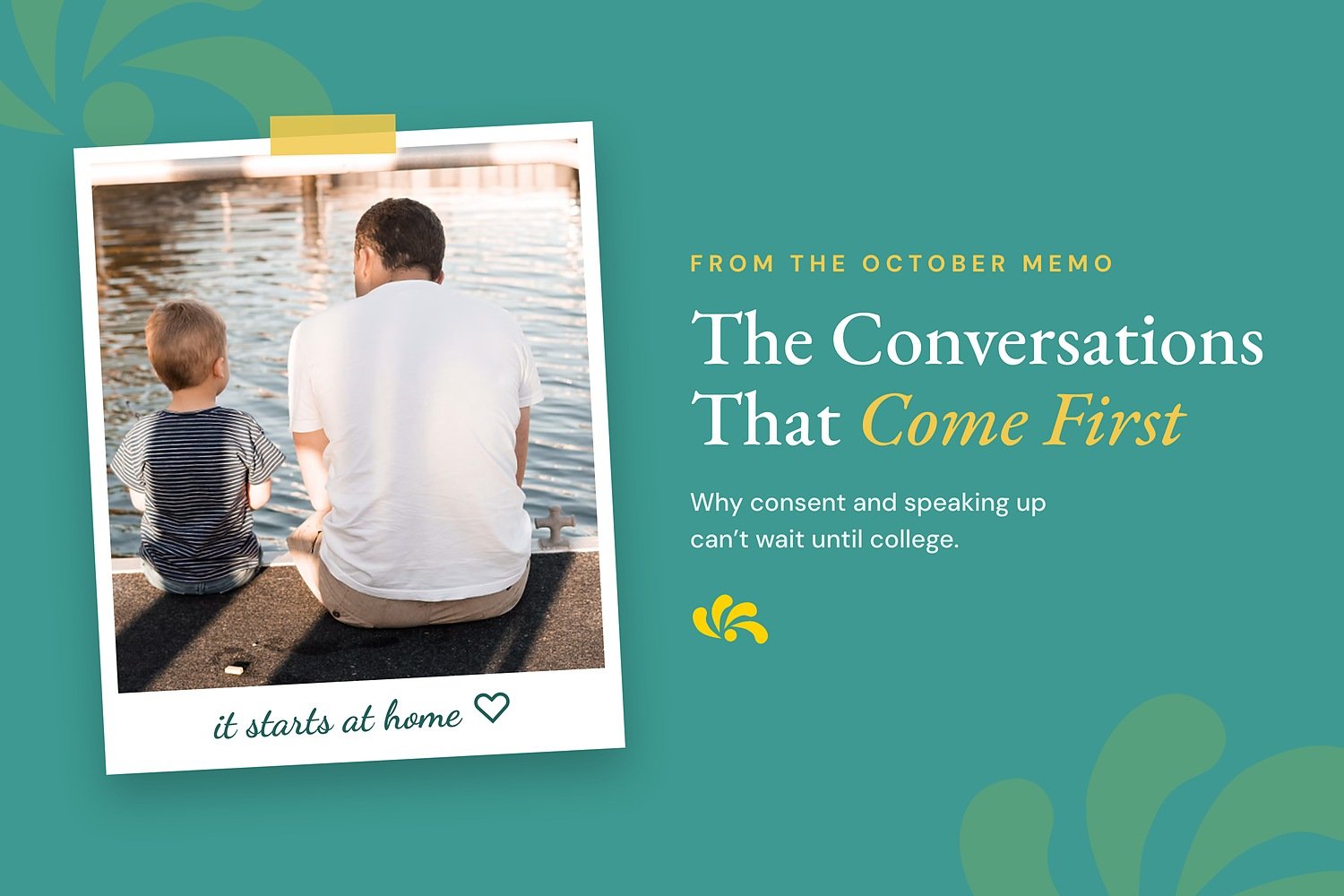
The Conversations That Come First

The Conversations That Come First

Many of you have likely seen the news out of Cornell University, where a former student has filed a lawsuit alleging she was sexually assaulted by multiple members of a fraternity at a party in 2024. The case has sparked protests, an independent review of how the university responded, and the appointment of New York’s attorney general as special prosecutor. The legal process is still unfolding, and no one has been criminally charged. Whatever comes next, our hearts are with her and with every survivor who sees their own story in headlines like this one.

We won’t try to make sense of something this painful in a few paragraphs. But it does bring us back to a question at the heart of our work: what are we teaching young people long before they ever walk into that party?

For generations, prevention advice has been aimed mostly at girls and women. Watch your drink. Don’t walk alone. Be careful what you wear. Those messages put the responsibility on the people being harmed. Real prevention asks something different. It asks every young person, and especially boys and young men, to understand consent, to see others as fully human, and to know that respect is not optional when no one is watching.

It also asks them to speak up. Harm like this rarely happens in a vacuum. It grows in cultures where a crude joke in a group chat goes unchallenged, where staying quiet feels easier than standing out, and where no one ever practiced what to say when something feels wrong. Those small silences are rarely meant to hurt anyone. Their consequences can be devastating anyway.

That is why these conversations can’t wait until college. They start with the basics, naming feelings, respecting “no,” and asking permission, and they grow into the harder ones: what consent really means, how to check on a friend, and how to step in when something isn’t right.

If you or someone you know has been affected by sexual violence, the National Sexual Assault Hotline is available 24/7 at 1-800-656-HOPE (4673) or online at rainn.org.

Empathy Is Prevention

Empathy Is Prevention

October holds both National Domestic Violence Awareness Month and National Bullying Prevention Month. They may sound like separate concerns, one about adults and homes, the other about children and schools. But they share a common root: how we treat one another, especially when there is a difference in power, and how much harm can grow when respect, boundaries, and empathy are missing.

Domestic Violence Awareness Month grew out of a “Day of Unity” that advocates first held in October 1981, and it became a national observance in 1987. National Bullying Prevention Month began in 2006 as a single week led by PACER’s National Bullying Prevention Center and grew into a full month in 2010. Bullying remains common today. In the most recent federal data, about one in five students ages 12 to 18 reported being bullied at school.

What links these causes is not only harm, but hope. The same skills that ease conflict on a playground build healthy relationships across a lifetime: recognizing another person’s feelings, honoring boundaries, handling disagreement without cruelty, and speaking up when something is wrong. Empathy is not a soft extra. It is one of the most powerful forms of prevention we have. Harm often grows in silence and in the belief that cruelty is normal, and empathy interrupts both.

Raising a More Empathetic Generation

If empathy is prevention, the question becomes how we teach it. For a long time, the well-meaning answer to a child’s hard question was to close the door on it. Don’t worry about that. You’ll understand when you’re older. Those responses were meant to protect, but they taught children that some things are not safe to talk about. If we want a kinder society, we have to teach differently, by taking children’s questions seriously and answering them honestly and age-appropriately.

Part of that teaching is helping children understand harm itself. Not everyone who hurts us meant to. Not every mistake we make is who we are. When young people grasp that harm can be unintended, they get better at two things at once: protecting themselves and extending grace to others. They learn to name what hurt without assuming the worst, and to own their missteps without drowning in shame. That is where forgiveness and compassion take root, and for a child it can be the difference between a grudge and a repaired friendship.

None of this is only for children. Patience, empathy, and the humility to hear one another are skills adults are still practicing too. When we model them, imperfectly and out loud, we give young people permission to keep growing. A more empathetic generation is not built through lectures, but through the steady example of adults willing to do the work alongside them.

A kinder community is not built in a single month. It is built in countless ordinary moments, in how we listen, how we respond, and what we choose to model.

If you or someone you know needs support, help is available and confidential. The National Domestic Violence Hotline is open 24/7 at 1-800-799-7233, or text START to 88788. To learn more about preventing bullying, visit StopBullying.gov.

Sources: National Resource Center on Domestic Violence; PACER’s National Bullying Prevention Center; National Center for Education Statistics, Condition of Education 2024 (2021-22 school year data).