
parenting

What If We Let Our Kids See Us Not Know?

What If We Let Our Kids See Us Not Know?

I have worked in adolescent sexual health for a very long time.

This means that when it comes to talking to my own children about sex and relationships, I am always calm, confident, perfectly informed, and never awkward.

Hahahahahaha.

No.

Like every other parent, I have had questions from my children that caused some part of my brain to yell:

WE WERE NOT PREPARED FOR THIS QUESTION TODAY.
Sometimes I know the answer but have no idea how much information my child is actually requesting.

Sometimes I start answering and realize I have gone approximately six exits past the information they wanted.

And sometimes? I genuinely don't know. I think parents can feel enormous pressure around this. Especially when it comes to sexual health.

We think we're supposed to know when puberty starts and exactly how every form of birth control works and what every new term means and what kids are doing online and how to answer every possible question about gender and sexual orientation and relationships.

This can lead to a strange outcome: Because we're afraid of giving the wrong answer, we avoid the conversation altogether.

But what if one of the most useful things we can say to our children is: “I don't know.”

Followed by: “Let's find out.”

Think about what this teaches.

First, it teaches children that sexual health is a legitimate area of knowledge.

There are facts.

There are credible sources.

There are professionals who know things we don't know.

We can ask questions and learn.

In other words, sex doesn't have to live in some mysterious category where everyone is supposed to magically know things, but nobody is allowed to talk about how they learned them.

Second, saying, “I don't know” gives our children permission not to know either.

This is important.

Young people live in a culture where it can seem as though everyone else already knows everything about sex and relationships.

Their friends know.

TikTok knows.

The internet DEFINITELY knows.

And nobody wants to be the person who raises their hand and says:


“Wait. What does that mean?”


But not knowing is normal.

Adults don't know everything about sex either.

We don't know everything about our bodies.

We don't know everything about relationships.

We don't always know why we feel the way we do.

Many of us are still learning about our bodies well into adulthood—during pregnancy, after childbirth, while navigating sexual health concerns, during perimenopause and menopause, and in a thousand other circumstances nobody thought to mention in seventh-grade health class.

So perhaps part of comprehensive sex education is modeling what learning looks like.

A child asks a question. We take a second. Maybe we say: “That's a good question. I'm actually not sure.”

Then we figure out where to look.

Maybe we find a reliable sexual health website. Maybe we ask a doctor. Maybe we say, “I know part of the answer, but I want to make sure I'm giving you accurate information.”

And sometimes we may even discover that the answer is complicated.

That's useful too.

Because someday, our children will be adults responsible for their own sexual health.

We won't be sitting beside them at every medical appointment.

We won't be there when they have a question about contraception or a new relationship or something happening in their body that they don't understand.

What we can give them now is something better than an encyclopedic parent. We can teach them:

Questions are okay.

Not knowing is okay.

Your body is worth learning about.

You deserve accurate information.

You can keep asking until you understand. And maybe most importantly: There is no shame in needing help figuring something out.

Which means that perhaps the next time one of our children catches us completely unprepared with a question about sex, bodies, or relationships, we don't have to panic.

We can take a breath and say: “Huh. I don't know.”

And then we can learn together.

That sounds like pretty good sex education to me.

Gail Cowan, MSW, is EOI’s Director of Development. A former therapist, she also runs her own coaching business. Find her at gail@gailcowan.com or gail@eyesopeniowa.org.


What If Our Kids Don't Need Us to Fix It?

What If Our Kids Don't Need Us to Fix It?

The other day, one of my children came to me with a problem. 

I will spare you the details because as my children get older, I am increasingly aware that their stories belong to them and not to me. But suffice it to say: something had happened. My child was upset. And I immediately knew what needed to be done.

Obviously. 

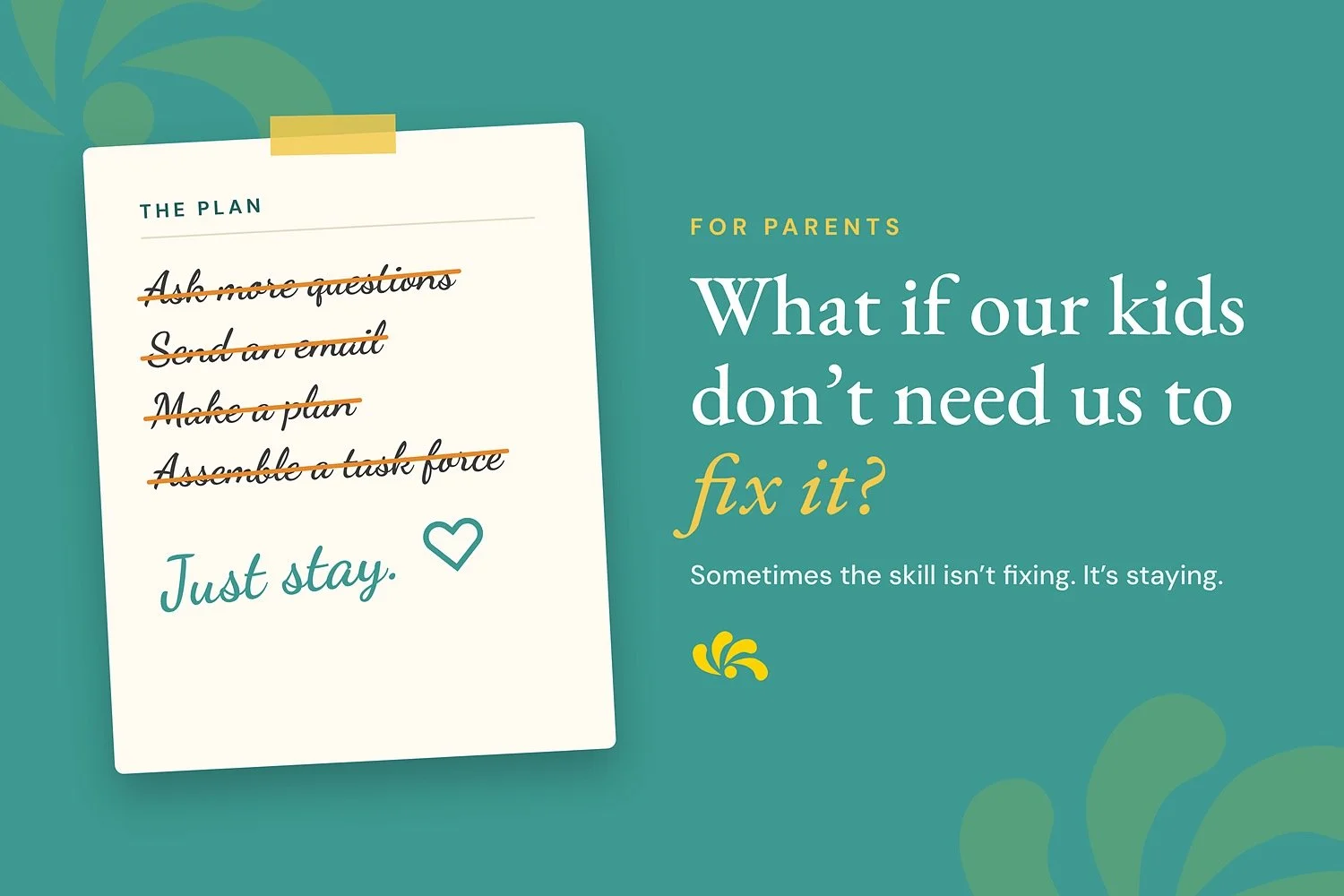
I had questions! Ideas! Strategies! I could send an email! We could make a plan! 

Within approximately 30 seconds, I had mentally assembled a small task force to address the situation.

My child, meanwhile, wanted none of this. 

Which was annoying, because my plan was excellent. 

If you are a parent or caregiver, you probably know this feeling. One of the hardest parts of raising children is watching them experience something difficult when we can see a possible way out. 

And when our children are small, fixing things is actually a significant portion of the job. 

Toddler can't reach the cup? We get the cup. 

Five-year-old can't tie a shoe? We help. 


Eight-year-old forgot lunch? We run over to the school and drop off a lunch or send them money to buy one. 

But somewhere along the way, the job starts to change. 

Increasingly, our children encounter problems that we could potentially fix but perhaps shouldn't: 

A friendship is difficult. 

They don't know whether they want to go to the party. 

Someone said something that hurt their feelings. 

They have a teacher they don't like. 

They like someone who may or may not like them back. j

They have to decide whether something feels right for them. 

And suddenly, the skill we're being asked to practice isn't fixing. j

It's staying. 

This is harder than it sounds. 

Because when someone we love is uncomfortable, their discomfort often creates discomfort in us. We want the bad feeling to stop. We want to reassure them. We want to tell them what to do. 

Sometimes we even mistake our own desire to stop feeling uncomfortable for helping. 

So what happens if, every once in a while, we don't? 

What if instead of immediately saying, “Here's what I think you should do,” we say: 

“Tell me more.” Or: “What do you think you want to do?” Or even: “That sounds really hard. Do you want ideas, or do you just want me to listen?” And for extra points, “I want you to know that I understand how bad this feels. I also know you will figure it out.” 


This may seem like a general parenting strategy—and it is. But I also think it has everything to do with sex education. 


Because someday, our kids will need to make decisions about relationships and bodies and sex when we aren't standing next to them. 


They will need to figure out: Do I want this? Do I feel safe? Do I actually like this person? Am I doing this because I want to, or because everyone around me seems to be doing it? Something happened that made me uncomfortable. What do I want to do now? 


There is no way to prepare them for every situation they will encounter. 
And that's why one of the most important things we can help them develop isn't a list of correct answers. 


It's a relationship with their own voice. 

We can help them learn that when something feels complicated, they don't have to immediately push the feeling away. They can get curious about it. They can take some time. They can talk to someone they trust.

They can make a decision—and sometimes change that decision later. 

And perhaps most importantly, they can learn that the people who love them don't need to take over in order to stay beside them. 

I am still practicing this. 

Sometimes I manage a calm, “What do you think?” Sometimes I make it approximately four minutes before saying, “Okay, but can I just tell you ONE THING?” 

Parenting is a process. 

But increasingly, I am trying to remember that my job isn't to make sure my children never struggle. It's to help them become people who trust themselves when they do. 

And that may be one of the most important ways we prepare them for everything that comes next. 

Gail Cowan, MSW, is EOI's Director of Development. A former therapist, she also runs her own coaching business. Find her at gail@gailcowan.com or gail@eyesopeniowa.org.

October is Let's Talk Month!

October is Let’s Talk Month. At EOI, we love Let’s Talk Month because it reminds us that conversations are the building blocks of sexual health!

 When we can talk about sexual health, we can normalize it. Safe, supportive conversation creates a resting place for human beings to return to when things get hard.

 But as so many of you know, there is a big difference between safe conversation and easy conversation. Especially when it comes to talking with our young people. Finding space for conversation between adults and teens can be a tricky skill to master. So many of us have felt this frustration!

 In honor of Let’s Talk Month, we thought we’d offer some tips for creating a space in which young people can open up and feel safe sharing thoughts and questions.

 The goal is never to get teens to speak every time we ask, but rather to become an “askable adult”. Being an askable adult simply means being a trusted source that young people can turn to when and if they want to chat.

 One of my favorite ways to ensure I’m an “askable adult” when it comes to sexual health and relationships is to work on becoming a safe space when the conversation isn’t centered around sex or relationships. Often, it can be easier to start there.

 As just one example, my oldest child, who is 11, has been feeling the school blues ever since school started three weeks ago. Predictably, these blues almost always come in the form of “I don’t like school!” and “I don’t want to go today!” every morning at about 7:45 before we walk out the door.

 Traditional wisdom as so many of us know from our own parents is to respond to these protestations with something like the following:

-       “I know, but it will be okay! You’ll get to see your friends.” OR

-       “You like school! You had so much fun yesterday.” OR

-       “You have to go. I have a big meeting today. Get in the car.”

 I have said every single one of these things multiple times out of panic and frustration. But over time, I have realized that such responses skip over my son’s feelings by either immediately offering a solution and/or telling him that his feelings aren’t real – or by centering my own feelings and what I have going on.

 We do this because we are panicked in the moment or because we just don’t want to DEAL. I get it. It’s so normal.

 But increasingly, I am working to engage another, more effective strategy that simply meets my son where he is – deep in his feelings. When I am in this parenting mode, I might say something like:

-       “I hear you and I believe you. Can you tell me where you are feeling this in your body?” OR

-       “I see how intense this feeling is for you every morning. Is there something I can offer you in the next minute or so – or after school – to help you deal with this pattern?” OR

-       “I’m so sorry. I know.”

 The tricky thing about kids is that they almost never come to you to talk about their feelings when they aren’t deep in the middle of said feeling. By nature, they process things as they come up (which is what a lot of adults do too, by the way!). And when you are five minutes late for school or a meeting and your child is experiencing an intense feeling, it can be hard to find the space – or patience – to work through them.

 But it helps to remember that our job as parents and caregivers is to prepare our young people for adult life, and as such, the fact that their feelings are happening in real time can be a beautiful opportunity to model how to best navigate future moments of stress.

 So we might say something like, “Being on time to my meeting isn’t super important today. I can be a few minutes late. Why don’t we sit together and breath?”

 We can take a moment to be with them in their feelings and ask them questions like, “What’s one thing you would change about school if you could?” or “Can you tell me more about it?”

And if we do actually need to be somewhere on time, we might say, “I’m so sorry that I have to leave now. But can we take some time after school to talk about this? Or a bit more time tomorrow morning if you’re struggling? I want to hear more.”

 Any response that leans toward compassion, expansiveness, and a feeling of security is what we’re aiming for here.

 Because isn’t kindness, safety, and expansiveness what we’re all searching for in moments of stress?

 The beauty is this approach is that it also allows space for us in moments of stress.

 And finally, it creates a beautiful building block for future conversations about more challenging things, like, you know, sex and relationships. Because such conversations also require space, safety, and compassion, too.

 We’d love to hear from you – what works for you to create safe spaces with your kids? Let’s talk!


Gail Cowan, MSW, is EOI’s Director of Development. A former therapist, she also runs her own coaching business. Find her at www.gailcowan.com or gail@eyesopeniowa.org.